Spaceship hatch
The TommyknockersThe Spaceship hatch is the buried vessel’s first unmistakable entrance and the point where excavation gives way to entry. Its discovery turns an immense, nearly featureless object from an apparent mass of metal into a structure with a boundary that can be crossed—and brings Bobbi and Gard to the threshold of the Tommyknockers’ secrets.
Discovery on the Ship’s Surface
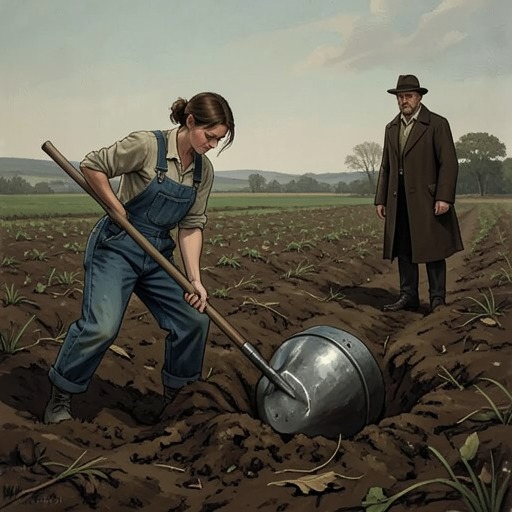
After a drill exploded, Bobbi pulled aside the broken rock and uncovered a single line in the ship’s otherwise featureless surface. Gard understood why she was excited and reached toward it. Bobbi warned him against touching it, recalling what had happened before, but he pushed her hand aside. The contact brought music into his head, muffled and fading quickly, and a rapid vibration in his teeth. He nevertheless took the groove for their first real sign that the vessel was not solid throughout: a possible way in and a glimpse of what lay behind its surface.
Bobbi identified the line as the hatch and said she had known it was there. The discovery gave their exhausting work a concrete destination. Gard told her they had done it; she embraced him and thanked him for coming back. His elation was complicated by revulsion at the jellylike movement of her body, a response he concealed from her. The entrance thus marks both their shared achievement and the growing unease in Gard’s relationship with Bobbi.
From Groove to Marked Opening
The pair continued by taking turns with a pick, working for roughly fifteen minutes at a time before clearing away the rubble together. By three that afternoon, Gard could see a circular groove about six feet across, resembling a manhole cover. At last, the surface also bore a symbol. He felt compelled to touch it, and the music in his head sounded louder—as though warning him to retreat before the ship’s protection failed. He touched the mark anyway, needing to confirm what he had found.
Pressed into the metal in bas-relief, the symbol suggested to Gard a sign devised by a being beneath another sun. He wondered whether it meant no trespassing, peaceful arrival, or something like a plague warning; none of these possibilities was confirmed. Its alien appearance instead produced a dread he likened to the awe of someone confronting an eclipse or the arrival of Halley’s Comet. The hatch is therefore not merely a practical opening: even before it is crossed, its markings make entry feel like a confrontation with an unknown order.
The Threshold into the Ship
Once Bobbi declared the excavation finished, she said that they would go inside the next day. Gard answered only after she repeated the plan. Bobbi described the dig as both impossibly long and seemingly recent, returning in memory to its accidental beginning: she had stumbled across the buried object, run her fingers over it, and brushed dirt away with one finger. She presented the hatch as the endpoint of that progression—from the first touch in the soil to an entrance ready to be crossed.
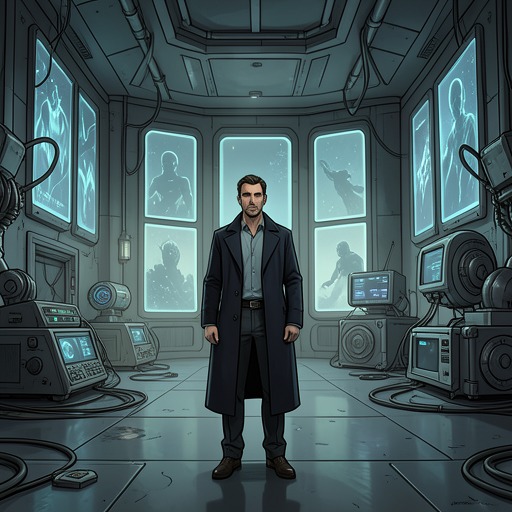
Inside, Gard looked along a corridor that was round except for a flat walkway halfway up one side. Its orientation initially seemed wrong; he then understood that the walkway and the corridor appeared canted because the ship itself lay at an angle. Soft light came from the featureless walls. The hatch thus opens not onto a familiar interior but onto a space whose construction and orientation unsettle ordinary expectations, extending the excavation’s physical threshold into a perceptual one.
Boundary and Narrative Significance
The hatch concentrates the novel’s movement from surface mystery to enclosed, alien space. For much of the excavation, the ship’s scale and polished, nearly blank exterior resist interpretation; a groove, then a circular outline and a symbol, make that material surface legible as a boundary. Yet each gain in knowledge intensifies danger: touching the metal produces music and bodily vibration, and the mark invites interpretations that remain unresolved.
This threshold also echoes the novel’s treatment of boundaries beyond the vessel. Haven’s residents imagine an enclosing barrier around the town, and Ruth experiences the air itself as a yielding resistance that pushes her back. Against those less visible limits, the hatch is a tangible passage: it promises access, but does not promise safety or understanding. Its opening brings the characters closer to the Tommyknockers while making clear that crossing into their world entails entering conditions they cannot yet comprehend.